


A small double can make room for a more generous sleep without taking over the bedroom, but the exact fit matters. In the UK, a 120cm bed mattress measures 120cm wide by 190cm long, also described as 4ft by 6ft 3in. European small doubles are 120cm by 200cm, so they’re 10cm longer.
Choosing the right size is only the beginning. In a compact room, the mattress needs to work with the bed frame, leave practical space around the bed and feel comfortable night after night. A difference in length can matter just as much as width, especially when matching a mattress to an existing frame.
Here, you’ll learn how UK and European small double dimensions compare, what to consider when choosing foam or spring support, and how different mattress types may suit a room with limited space. Understanding size and construction can make the decision simpler and help you choose a bed that fits the room without crowding it.
Key Takeaways
- Match the mattress dimensions to the bed frame: UK small doubles are 120cm x 190cm, while European versions are 120cm x 200cm.
- Compare foam, pocket-sprung and open-coil constructions by the feel and support you prefer, not by the mattress label alone.
- Check mattress depth alongside width and length, as it can affect the fit of bedding and the overall feel of the bed.
- In a compact room, consider how the bed’s width and length affect movement and usable floor space.
- Explore how mattress materials and spring types differ before choosing an option for your room and sleeping needs.
Small double mattress dimensions
A UK small double measures 120cm wide by 190cm long, giving two sleepers more width than single mattresses. That compact footprint can suit a bedroom where a standard double would take up too much floor space.
Standard and European Dimensions
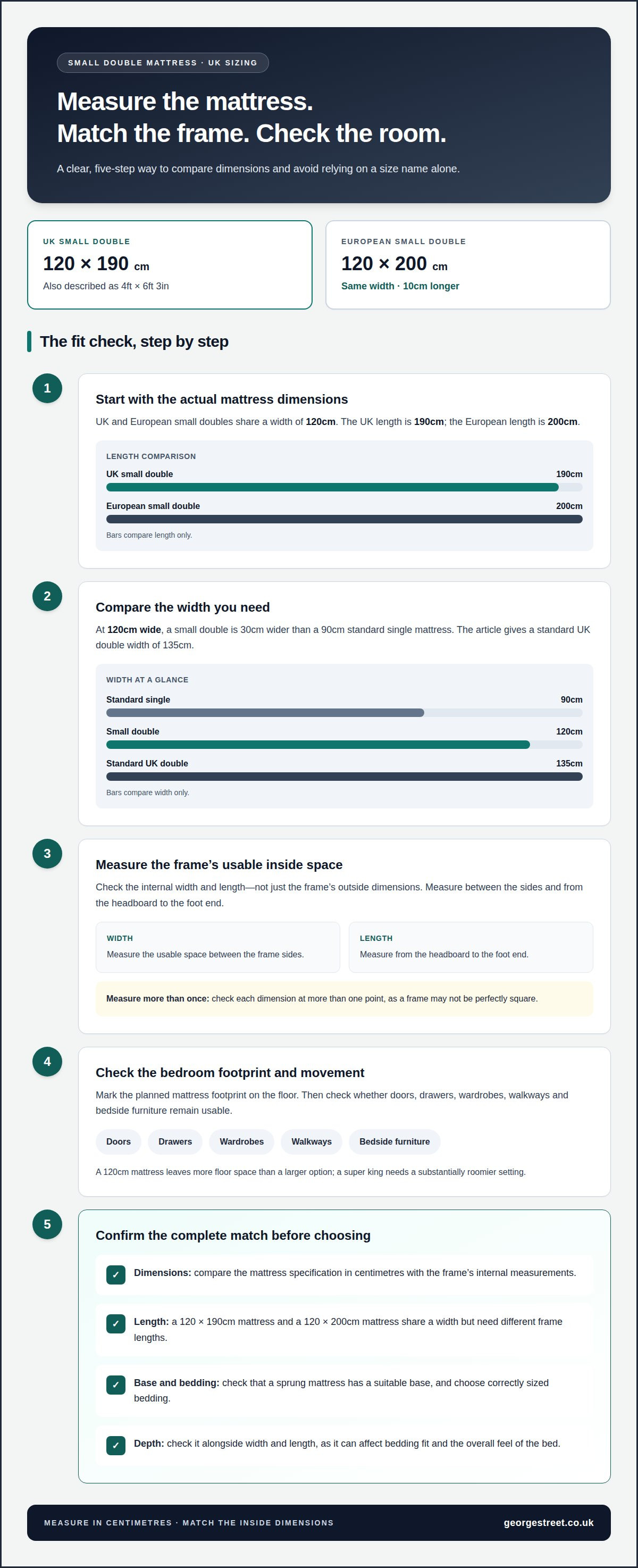
In the UK, a small double mattress is 120cm x 190cm, also known as 4ft x 6ft 3in. A European small double measures 120cm x 200cm, so it shares the width but adds 10cm of length. Compare both measurements with the bed frame, not just the label, before choosing a mattress. A European size may not fit a UK frame designed for the shorter length.
Width and Longer Size Comparisons
At 120cm wide, a small double is 30cm wider than a 90cm standard single mattress. It is also narrower than the 135cm width given for a standard UK double mattress. The European version keeps the same 120cm width and extends to 200cm long. This distinction matters if “4ft” describes the width you need, while extra length is the priority.
Check the frame’s inside dimensions before ordering. Measure the usable space between its sides and from headboard to foot end, then compare those measurements with the mattress specification. For example, a frame made for 120cm x 190cm may not accommodate a 120cm x 200cm European mattress, even though both are described as small doubles. A sprung mattress also needs a suitable base for its particular construction.
Mattress prices vary with materials, construction and depth. A basic foam design and a pocket-sprung model may cost different amounts because their materials and support systems differ. Compare like with like: check the dimensions, filling, spring type and stated firmness before considering price. That makes it easier to judge what each option offers, rather than treating the lowest price as the only measure.
Room layout can help settle the choice between a small double and a wider bed. A 120cm mattress leaves more floor space than a larger option, while super king mattresses need a substantially roomier setting. Mark the mattress footprint on the bedroom floor, then consider access to wardrobes, doors and bedside furniture. This simple step shows whether the chosen width works with the room’s everyday movement.
There is no fixed replacement interval that suits every mattress. Replace one when it no longer supports comfortable sleep or shows clear wear, and maintain it by following the maker’s care instructions, airing it and rotating it when advised. For a 120cm mattress, use correctly sized bedding and avoid folding or bending it, which can strain its materials.
Mattress size selection in centimetres
Choose by measured dimensions, not by a familiar size name alone. A mattress must suit both the sleeping space and its base, especially when the bed has a less common length.
Compare mattress sizes in centimetres
Use these UK measurements to compare common options: a small double is 120 x 190 cm; a standard double is 135 x 190 cm; and a double is also listed at 140 x 190 cm. A standard single measures 90 x 190 cm, while a long single measures 90 x 200 cm. King size is 150 x 200 cm, and Euro King is 160 x 200 cm. Measure the available spaces before selecting a mattress.
- Small double: 120 x 190 cm.
- Double: 140 x 190 cm.
- King: 150 x 200 cm.
- Euro King: 160 x 200 cm.
Custom-size divans and bed bases
A 120 x 200 cm mattress is longer than the UK small double size. It may need a custom-size divan to accommodate that extra length. Check the base’s usable sleeping area, not only its external dimensions, because the frame can extend beyond the mattress footprint. Match both length and width before ordering a mattress and base together.
For compatibility, measure the inside width and length of the bed frame. Take each measurement at more than one point, since a frame may not be perfectly square. Compare the results with the mattress dimensions, then consider how the mattress will sit beside the headboard and foot end. A 120 x 190 cm mattress and a 120 x 200 cm mattress share a width, but need different lengths.
Allow for fit and size names
There is no tolerance figure here to use as a substitute for accurate measuring. Don’t assume a mattress will fit because its name sounds close to the frame size. In particular, “Prince size” alone doesn’t tell you the length and width. Read the product’s dimensions in centimetres, then compare them with the frame’s internal measurements. This keeps naming differences from dictating a poor fit.
Measure the room as well as the base. Mark the planned mattress footprint on the floor, then check whether doors, drawers and walkways remain usable. A 150 x 200 cm king size needs more width than a 120 x 190 cm small double; that difference can change how furniture fits around the bed. For a coordinated mattress and base choice, explore beds and mattresses alongside your measurements.
Memory foam and pocket-sprung options
Foam, pocket-sprung and hybrid mattresses are available in small double sizes. Compare their support construction, depth and firmness, then check the delivery terms for the specific mattress you’re considering.
Foam, Pocket Spring and Hybrid Types
A foam mattress uses foam for its support, while memory foam adds a comfort layer designed to respond to body shape. Pocket-sprung designs use separate springs within individual fabric pockets; hybrids combine spring support with foam layers. The collection includes 35 mattresses with memory foam comfort layers and 14 with pocket spring support, offering different constructions to compare.
Specific examples show how construction and depth vary. The Superior Memory Foam Mattress is 20cm thick, medium-firm and includes a 50mm memory foam layer. The Maxitex Deluxe Pocket Sprung Mattress is 16cm thick, with medium memory pocket-sprung construction. The Galaxy Standard hybrid mattress is listed at 8 inches (20cm) deep. These examples help distinguish mattress type from overall thickness.
Open-coil support is another spring option, and the collection includes 28 mattresses with this construction. In a pocket design, each spring sits in its own pocket; an open-coil design uses connected springs. A hybrid brings spring and foam elements together. Compare the listed construction and comfort layers rather than assuming all sprung mattresses feel alike.
Thickness and Firmness Choices
Small double mattresses in the collection range from 10cm to 36cm deep. A thinner mattress can suit a lower-profile setup, while a deeper design changes the bed’s overall height. Check the frame and bedding alongside mattress depth. The Superior Memory Foam Mattress is 20cm deep, while the Maxitex Magic Memory Foam Mattress is 15cm thick and medium firmness.
Firmness descriptions help narrow a choice, but they don’t replace considering the construction and comfort layers. For example, the Superior Memory Foam Mattress is described as medium-firm, while the Maxitex Magic Memory Foam Mattress is medium. The collection includes 23 mattresses listed as medium firmness. Use these labels as a comparison point, then consider which surface feel suits your sleeping preferences.
Delivery wording describes a separate choice. “Express delivery” means a faster delivery option; “free delivery” means no separate delivery charge under the stated terms. Neither phrase describes mattress construction or firmness. Before planning around a delivery date, read the specific listing’s terms, including any stated timing and conditions. These details are separate from whether a mattress uses foam, pocket springs or a hybrid design.
For a practical comparison, note the mattress type, depth and firmness together. A 15cm medium foam option and a 20cm medium-firm hybrid differ in both construction and feel, even if they share the same bed size. That simple comparison keeps comfort choices distinct from delivery arrangements.
Choosing a mattress for limited space
In a compact bedroom, mattress choice affects both sleeping space and the clear floor around the bed. Compare the mattress footprint with doorways, drawers and walking routes before settling on its width or length.
To check whether a 120cm mattress will fit, measure the bed frame’s internal width and length, then compare them with the mattress measurements. Measure the open floor area too, including the space needed to reach wardrobes and open doors.
Width and length work together. A 120cm-wide small double offers more sleeping width than a 90cm standard UK single, while a standard single measures 3' x 6'3 and a long single measures 3' x 6'6. For a narrow room, a single may preserve more usable space; a small double gives a broader sleeping surface. Choose according to the people using the bed and the room’s layout.
Sketch the footprint before buying. Mark the bed’s width and length on the floor with removable tape, then walk around the outline and open nearby drawers. If a wardrobe drawer meets the taped edge, a narrower mattress or a different orientation may make the space more practical. Include the frame’s outer dimensions in your plan, since its sides can extend beyond the mattress.
Length matters just as much as width. A 120 x 200cm mattress is longer than the UK small double length of 190cm, so compare it with the frame and available floor area. A smaller width won’t solve a length problem if the bed reaches into a doorway or blocks access to furniture.
Mattress tension, often described as firmness, is a separate choice from size. Start with the feel you prefer, then compare the construction and firmness description. A medium or medium-firm label can help narrow the options, but it doesn’t change the dimensions. If you share the bed, consider whether both sleepers find the surface comfortable rather than choosing by room size alone.
Spring construction also affects how a mattress feels. A pocket-sprung mattress has individual springs in pockets, while open-coil support uses connected springs. Compare these designs with foam options and consider how each may suit your needs. The smallest footprint isn’t automatically the best fit if it compromises comfort.
Before ordering, follow this sequence: measure the inside of the frame, check the mattress length and width, map the bed’s outer footprint, then make sure drawers and doors still move freely. This practical check helps balance sleeping space with the room’s everyday use.
Mattress materials and types
Materials influence how a mattress feels, while its dimensions determine how it fits the bed and room. Compare its layers and support construction with the frame and your preferred sleeping feel.
Comfort-Layer Materials
The comfort layer is the surface material you lie on, and its composition can change the feel of a mattress. Memory foam is one option; some designs combine it with springs, while foam mattresses use foam for support. Compare the stated layer materials and thicknesses rather than relying on labels alone. For example, one mattress uses a 50mm memory foam layer.
Natural fibres offer another material choice. They can settle by up to 2 cm over time, so consider how that change may affect the sleeping surface. Look for the named materials and their position in the mattress layers. A comfort layer and a support core serve different roles, even when both use foam or fibres.
Mattress Material Options
Mattresses may use foam, natural fibres or spring systems, and some designs combine materials. Open-coil support uses connected springs, while pocket-sprung models place springs in separate pockets. Hybrid mattresses combine spring and foam components. Compare the listed construction and layers to understand what provides support and shapes the surface feel.
Material choice also connects to mattress depth and the bed frame. A mattress listed at 15cm and one listed at 20cm differ in overall height, even if both use memory foam. Check how the chosen depth sits on the frame and how it changes the finished bed height. For a 200 cm mattress, also make sure the base provides the matching length.
Size doesn’t determine material. A 120cm-wide small double can use different constructions, just as super king mattresses can. Keep the size decision separate from the material decision: first match the mattress to the frame, then compare comfort layers, support type and stated firmness. That prevents a familiar label from obscuring meaningful differences between two models.
Use a simple comparison when narrowing options. Note the core material, comfort layer, support type and depth for each mattress. For example, record “foam support, memory foam layer, 20cm deep” separately from “pocket spring support, foam comfort layer”. This makes the construction easier to compare without assuming two mattresses feel alike.
Once those details are clear, compare bed and mattress options with your chosen size and material preferences.
George Street Furnishers: Sofas
George Street Furnishers offers beds and mattresses for readers ready to turn measurements and material preferences into a considered choice. If you’ve compared small double dimensions, spring types and comfort layers, browsing the beds and mattresses range is a practical next step. It lets you explore options for your bedroom while keeping the frame size and preferred feel in mind.
A useful shortlist includes the required width and length, bed base dimensions, preferred firmness and mattress construction. Bring those details together before deciding, especially if your frame needs a particular size. This helps you choose for the room and the way you sleep, rather than relying on a label alone.
Contact George Street Furnishers to discuss your bed and mattress choice.
Make your next bedroom choice with confidence
The right 120cm bed mattress should feel at home in your room and support the way you want to sleep. Before choosing, bring your measurements and preferred feel together, then select an option that makes the space work beautifully for everyday life. A considered choice can turn a compact bedroom into a more restful, personal retreat.
For a next step, explore the bed and mattress options at George Street Furnishers, or contact George Street Furnishers to discuss your choice. The business also offers sofas and aluminium pergolas for other parts of the home. Take your time, trust the details that matter to you, and choose a bedroom centrepiece that feels right for the life lived around it.
Frequently Asked Questions
What are the standard dimensions of a 120cm bed mattress in the UK?
A 120cm bed mattress in the UK is 120cm wide by 190cm long. That is the small double size, also described as 4ft by 6ft 3in. Use the centimetre measurements when comparing a mattress with a frame, since familiar size names can vary between listings. Measure the frame’s inner space and check both dimensions before choosing, particularly if the bed was made for a different mattress standard.
Is a 120cm mattress the same as a small double mattress in the UK?
Yes. In the UK, a mattress 120cm wide is classed as a small double when it measures 190cm long. The width alone doesn’t establish the full size, because a European small double can share that width but measure 200cm long. For example, compare the product dimensions with the bed frame rather than relying only on “small double” in the listing.
What mattress length is available for a 120cm-wide UK bed?
The standard UK small double length is 190cm. A 120cm-wide European small double is available at 200cm long, which adds length without changing the width. That longer mattress may need a base designed for its dimensions. Measure from the headboard to the foot end and check the usable space, especially if the frame has fixed ends or a built-in headboard.
How much does a 120cm mattress cost in the UK?
There isn’t one fixed cost for a 120cm mattress: the price depends on its construction, materials, comfort layers and depth. A foam design and a pocket-sprung model use different support systems, while added layers can also affect the specification. Compare mattresses with similar dimensions and construction to understand what accounts for differences between options, rather than judging by the size label alone.
How do I choose the right firmness for a 120cm mattress?
Choose firmness by considering the feel you find comfortable, then compare the mattress construction and firmness description. “Medium” and “medium-firm” describe different feels, not mattress size. If you share the bed, discuss your preferred surface feel together. Comparing foam and spring constructions can also explain why mattresses with similar firmness labels may feel different.
What bedding size fits a 120cm mattress in the UK?
For a 120cm x 190cm mattress, choose small double bedding labelled for those dimensions. A small double fitted sheet listing specifies a mattress size of 120cm x 190cm and a 30cm-deep pocket. Check the mattress depth as well as its width and length before buying a fitted sheet or protector. A 200cm-long European small double needs bedding made for its longer size.