


A bookshelf can look more considered when it holds fewer things, not more. If you’re wondering how to style a bookshelf, you don’t need to hide every well-loved book or fill every gap with a decoration. Instead, find a rhythm between useful storage and personal expression, so the shelf feels balanced, lived-in and distinctly yours.
Books can crowd together, ornaments can seem disconnected, and empty space can feel like something you ought to fill. But a little breathing room helps favourite books and meaningful objects stand out, while keeping the titles you reach for close at hand. Aim for a cohesive display that still feels comfortable to live with.
In this step-by-step guide, you’ll learn how to edit what you have, arrange books vertically and in stacks, choose objects that belong in the story, and leave space for the eye to rest. You’ll also find ways to adjust the balance as you go, creating a bookshelf that brings warmth and character to your home.
Key Takeaways
- Before arranging anything, decide whether your shelf is mainly for storage, display or a practical mix of both.
- Choose a symmetrical, asymmetrical or colour-led arrangement to suit your books and the look you want.
- Combine upright books, short horizontal stacks and a few meaningful objects to add variety while keeping books accessible.
- Learning how to style a bookshelf doesn’t require matching accessories or new purchases. Work with your shelf’s shape and the belongings you already own.
- Step back to review the display, remove anything that feels excessive and refresh it with items from elsewhere at home.
How to Style a Bookshelf: Start with a Clear Plan
A polished bookshelf doesn’t need a matching set of accessories or a fresh collection of books. Well-thumbed favourites, a treasured photograph and a small object with a story can give it more character than items bought just for display. The first step in learning how to style a bookshelf is deciding what you want it to do in everyday life.
Some shelves are hardworking storage for reference books, paperwork or the stories you return to often. Others display keepsakes and bring personality into a room. Most do a little of both. Visual balance is the relationship between the objects, colours and open space on a shelf. Keeping that in mind helps you create a considered display without making the shelf difficult to use.
Decide what your bookshelf needs to do
Think about who uses the shelves and what they need to reach. In a family living room, children’s books might belong within easy reach, while delicate keepsakes sit higher up. In a home workspace, reference books and current paperwork may need to stay accessible. Elsewhere, a shelf might give favourite novels and personal mementoes room to shine.
Separate the items you reach for regularly from those you’re displaying mainly for their visual or personal value. Keep useful books easy to take down and put back, then use meaningful objects to add details that make the arrangement feel like yours.
Edit and group before arranging
Temporarily remove everything from the shelves. Looking at the bare surface makes it easier to judge its proportions and gives you a clean start, rather than encouraging you to squeeze new arrangements around old ones.
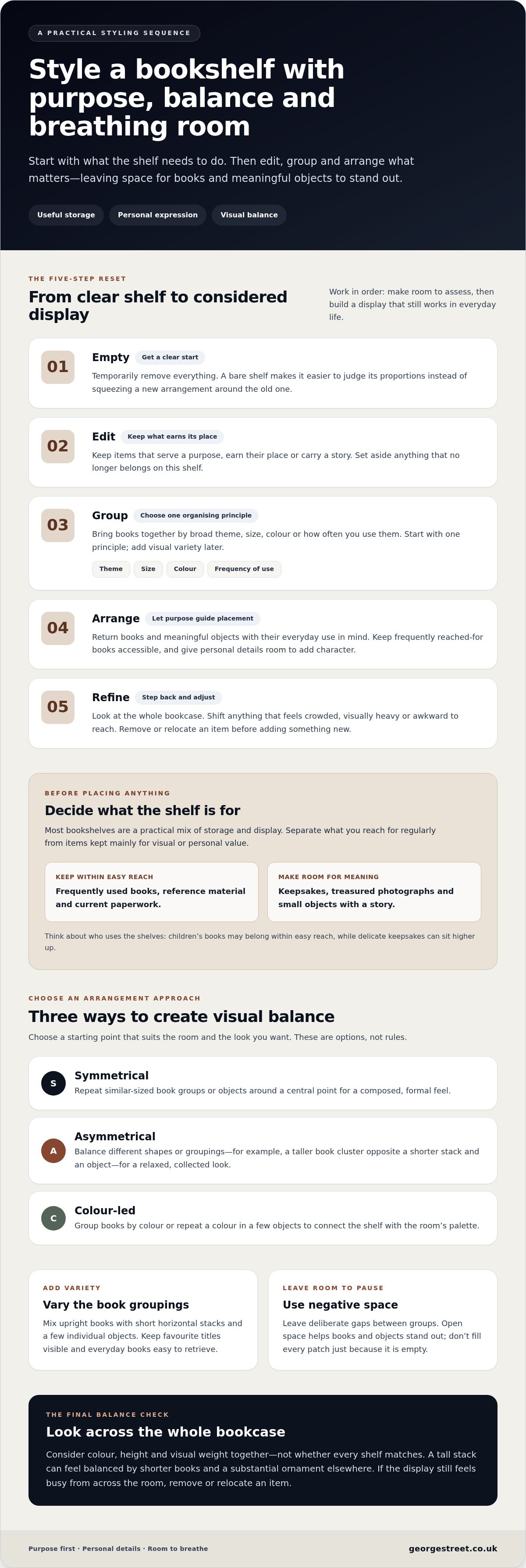
Next, edit and group. Keep the books and objects that serve a purpose, earn their place or carry a story. Set aside anything that no longer belongs on this shelf. Choose one organising principle for your books first: broad themes, size, colour or how often you use them. You can add visual variety later, but starting with one principle makes the task more manageable.
Then follow a simple sequence:
- Empty: Clear the shelves so you can assess them properly.
- Edit: Set aside items that don’t support storage or display.
- Group: Bring together books using your chosen organising principle.
- Arrange: Return books and meaningful objects with their purpose in mind.
- Refine: Step back and adjust anything that feels crowded or awkward to reach.
Start with function, then add the personal details. A shelf that works for the people who live with it will feel natural, and its objects will have room to tell their stories.
Build Bookshelf Balance with Colour, Height and Negative Space
A balanced bookshelf doesn’t mean every shelf must match or each object needs a partner. It means the books and objects feel considered together. A tall stack on one side, for example, can be balanced by shorter books and a substantial ornament on the other. Look at the overall spread of colour, height and visual weight instead of trying to make every shelf identical.
Choose a bookshelf arrangement that suits your room
There’s no single right arrangement. Symmetry can create a calm, orderly feel, while asymmetry often looks more relaxed and collected. A colour-led layout can make books feel part of the room’s palette, but it doesn’t have to mean arranging every spine in a strict rainbow. Try one approach, step back and adjust before adding more objects.
Symmetrical: Repeat similar-sized book groups or objects on either side of a central point. This is useful if you prefer a composed, formal look.
Asymmetrical: Balance different shapes or groupings across the shelf, such as a taller book cluster on one side and a shorter stack with an object on the other. This suits a more relaxed display.
Colour-led: Group books by colour, or repeat a colour in a few objects. This can help the shelf sit comfortably within a room that already has a clear palette.
Use these as starting points, not rules. If one shelf looks heavier on the left, shift a group or move an object to the right. The aim isn’t exact equality, but a pleasing distribution that lets the eye travel across the whole bookcase.
Use colour and open space with intention
Colour-sorting works best when you like the effect and it connects with the room around it. If finding a book by subject or title matters more, keep your existing organisation and use a few repeated colours or materials to create continuity. A ceramic piece, a wooden frame and book spines in related tones can link separate parts of the display without making every shelf identical.
Negative space gives books and objects room to stand out, turning a crowded row into a display the eye can pause on. Leave deliberate gaps between groups rather than filling every open patch. A small clear area beside a stack can make both the books and the object next to them feel more distinct. If the shelf still looks busy from across the room, remove or relocate an item before introducing anything new.
Arrange Books and Decorative Objects for a Layered Display
Once you’ve decided what belongs on the shelf, vary the arrangement. A mix of upright books, short horizontal stacks and a few individual objects creates more interest than a continuous row of spines. Add variety without making favourite titles hard to spot or everyday books awkward to retrieve. Thoughtful placement can make a bookshelf feel personal and practical at the same time.
Mix vertical and horizontal book groupings
Keep books you use often upright, with their spines visible, so you can find and remove them easily. Add a short horizontal stack to break up the line of upright books. A small, lightweight object can sit on top if the stack is stable and the object won’t make the books difficult to handle.
Vary the height of each grouping rather than arranging every book to the same level. For instance, place a taller run of novels beside a lower row of slimmer volumes, then leave room for an object between them. Avoid tall or wobbly stacks, which can be difficult to reach and may shift when you pull out a book. Keep books you need regularly within easy reach rather than beneath a decorative display.
Place meaningful objects without overcrowding
Choose objects for their connection to you, their texture or the contrast they bring to nearby books. A framed photograph, a ceramic piece or a small houseplant can all work, but none is essential. An item already in your home may carry more meaning than a new ornament chosen just to fill a gap.
Give each focal object a little room, and vary its scale against the books around it. A low object might sit beside taller spines; a framed photograph can lean near a compact stack, provided it’s stable and doesn’t block titles you need to see. Repeating a shape or material lets varied objects feel connected without making them look like a matching set. For example, a rounded form echoed in a photograph’s circular detail can create a quiet link between pieces.
Keep the arrangement easy to live with. Place delicate keepsakes away from spots where they might be knocked, and position heavier objects securely where they’re comfortable to lift. Try taking books in and out as you arrange. If the display gets in the way, edit it. The best guidance on how to style a bookshelf is simple: let objects add character, but keep books practical to use.
Adapt Bookshelf Styling to Different Shelves and Everyday Needs
An attractive bookshelf doesn’t depend on matching accessories or costly purchases. Its character is already there in your books, keepsakes and everyday belongings. Shape the arrangement around the shelf itself: its depth affects how much you can layer, its height influences where different items sit, and its contents determine how much room is available for display.
Style open, compact and heavily used bookshelves
Open shelving can be seen from more than one angle, especially if it divides two areas of a room. Keep the composition coherent from both sides, and consider the viewpoints people actually use. If the shelves are compact, limit the number of decorative groupings and give frequently used books first claim on accessible space. A crowded display can make a small shelf feel even busier.
For shelves used by the whole household, make practical categories easy to recognise and return. Keep cookbooks together near where they’re used, for example, or give children’s stories a reachable place. You can still include a treasured object, but leave room to take books out and put them back without disrupting the whole arrangement.
Keep the display personal and functional
Choose things connected to real interests: books you return to, a souvenir with a story or an object linked to a hobby. There’s no need to follow a rigid trend or make every shelf look alike. Furnishings can work together across a room while each piece expresses its own character. Explore furniture for the wider room as you consider how your bookshelf sits alongside the rest of the space.
Let everyday routines guide placement. Keep frequently handled books and objects within comfortable reach, and set fragile pieces away from busy walkways or places where they could be knocked. If children share the shelves, reserve lower, easy-to-access areas for sturdy items they use often.
Let the arrangement change with you. A new interest, a growing book collection or a shift in how a room is used may call for a different balance. Move items around as needed, keep what still serves a purpose and let the shelf reflect the life happening around it. This is the heart of how to style a bookshelf: make it pleasing to look at, but practical enough for everyday life.
Finish, Refine and Maintain a Bookshelf That Feels Like Yours
The final edit helps a shelf feel considered rather than simply filled. Step back and look at the whole bookcase, not just the individual objects. Notice where colour, height or visual weight gathers, and whether one area feels crowded beside another that looks bare. Then check that the display still works for the people who use it.
Use a final bookshelf styling checklist
- Look at the whole: Check whether colour, height and visual weight are spread across the shelves rather than concentrated in one spot.
- Test everyday access: Make sure you can find and remove frequently used books without shifting a decorative arrangement.
- Check stability: Ensure objects sit securely and aren’t likely to be knocked when books are taken down.
- Edit with care: If the shelf feels crowded, remove one item and review the result from across the room.
That last step can make a surprising difference. Removing a single object may give a favourite book or keepsake room to be noticed. If taking something away makes the arrangement feel calmer, leave it elsewhere rather than replacing it with another ornament.
Refresh the display without starting over
A refresh doesn’t need a full rearrangement. Rotate a few objects, move a book grouping to another shelf or bring a much-loved item into view from elsewhere in your home. Small changes can make a familiar display feel new while keeping its most meaningful pieces in place.
Let changing interests and routines guide your edits. A new hobby might give a different group of books pride of place; a change in how you use the room may mean moving everyday titles within easier reach. After living with each change, notice whether items return to their places and whether the shelf still feels natural to use. If not, adjust again. Learning how to style a bookshelf is an ongoing process shaped by the books and belongings that matter to you.
Above all, keep the arrangement personal. It doesn’t need to follow a trend or stay fixed through every season. For broader inspiration on how furnishings work together across a room, explore furniture for the home, and let your own taste lead the final choices.
Let Your Bookshelf Tell Your Story
A shelf that feels finished doesn’t need to be perfect. Start with what it needs to do, arrange books and meaningful objects with care, then leave enough breathing room for each part of the display to be seen. The best approach to how to style a bookshelf balances visual interest with everyday use, keeping favourite reads easy to reach and the details true to you.
Step back before you call it done. If one area feels crowded, edit it; if your routine or interests change, let the arrangement change too. Small adjustments can keep a bookshelf fresh without losing the stories and objects that make it personal.
Thoughtful surroundings come together one choice at a time. George Street Furnishers is a family-run independent business with more than 75 years of experience, offering furniture and home-living products with nationwide UK delivery. Explore furniture for your home and find inspiration as you shape a space that feels welcoming and distinctly yours.
Frequently Asked Questions
How do you style a bookshelf without making it look cluttered?
Start with a clear surface, then return only books and objects that are useful or meaningful. Group similar items, mix upright books with short horizontal stacks, and leave open space between arrangements. As you work out how to style a bookshelf, keep everyday titles easy to reach. Step back to view the whole display, then move or remove anything that makes one area feel crowded.
Should books on a bookshelf be arranged by colour or by subject?
Choose the arrangement that best suits how you use your books and the look you enjoy. Grouping by subject or use makes titles easier to find, while sorting by colour can create a more unified visual effect. You can combine the two by keeping practical categories together and repeating a few colours across the shelf. There’s no need to sort every book if a simpler approach feels more natural.
How do you make a bookshelf look balanced?
Distribute visual weight across the shelves instead of placing all the tall books or larger objects in one area. Mix upright rows with shorter horizontal stacks, vary the height of groupings, and repeat a colour or material to connect separate objects. Leave some space between arrangements, then look at the shelf from across the room. If one side feels heavier, shift a group or reposition an object.
How much empty space should you leave on a bookshelf?
There’s no fixed amount of empty space that works for every bookshelf. Leave enough breathing room for books and objects to remain visible and easy to use. If every shelf looks full, remove a few items and step back to see how the display changes. The right balance depends on the shelf’s purpose, its contents and your taste. Open space can be part of the arrangement, not a gap that needs filling.
Can you style a bookshelf with books you already own?
Yes, books you already own are a lovely place to begin. Sort them into useful groups, then try upright rows alongside short horizontal stacks to vary the display. A few personal objects from elsewhere in your home can add meaning or contrast. Matching accessories aren’t necessary. Editing and rearranging what you have can make the shelf feel more considered while keeping favourite books close at hand.
How do you style a small bookshelf?
Give a small bookshelf a clear purpose and prioritise the books you reach for often. Group similar titles together, then use a few varied heights to add interest without crowding the shelf with objects. Leave some open space so the arrangement feels calm and remains easy to use. After living with the layout, check that books are simple to find and return, and adjust anything that gets in the way.